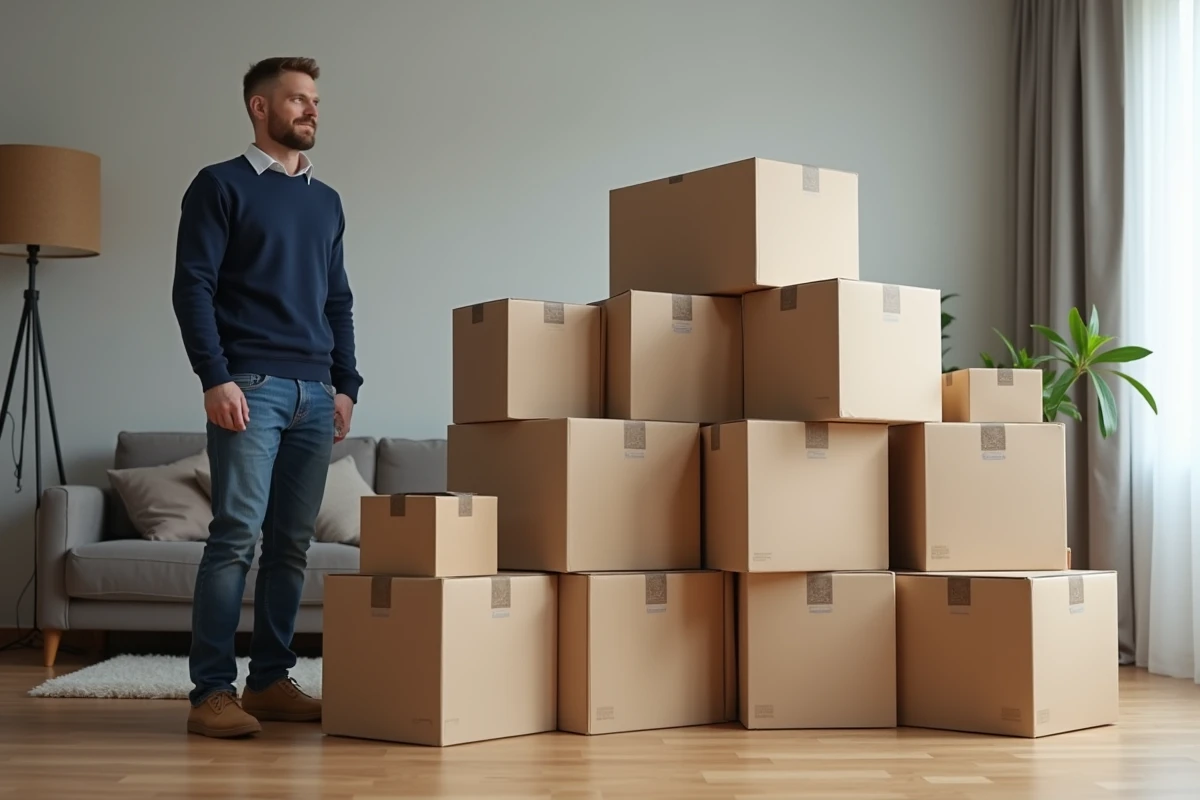
Estimating a volume of 3 m³ often leads to errors, even among professional movers. Some large pieces of furniture occupy only a fraction of that space, while smaller items, stacked or poorly organized, can fill a truck much faster than anticipated.
Online tools offer quick estimates, but their effectiveness depends on the accuracy of the data entered. The correlation between common items and cubic meters remains unclear for many, leading to surprises during loading. Evaluation methods vary according to needs, but a few simple guidelines can limit unpleasant surprises.
What does 3 m³ correspond to in everyday life?
Visualizing what 3 m³ represents requires momentarily setting aside the purely mathematical notion to return to the reality of familiar spaces. Imagine a wall closet that is 2 meters wide, 1 meter deep, and 1.5 meters high: this is a concrete example of 3 cubic meters. Surprisingly, this volume already swallows a significant portion of the furniture in a typical room.
To navigate a home, an empirical rule applies: divide the area in m2 by two, and you get an approximate idea of the volume needed to store the furniture of a standard room. Thus, a 10 m2 bedroom often requires around 5 m3 for all its furniture, but 3 m3 is sufficient for a double bed, a dresser, and a few carefully arranged boxes.
The volumes occupied by large furniture can vary, but a few benchmarks help clarify: a straight sofa approaches 1.5 m3, a two-door wardrobe reaches almost 1 m3, and a compact dining table with four chairs totals about 1 m3. To complete the three cubic meters, simply add boxes, a few chairs, or small appliances. A studio of 15 to 20 m2 typically requires between 6 and 10 m3 to move all its contents, positioning 3 m3 as a perfectly suited volume for targeted transport, such as for a student’s equipment, an office, or temporary storage.
The presence of bulky items like a piano or a large sofa can disrupt the balance: such pieces quickly occupy all available space. To get a concrete idea, the page “Ideal Dimensions for a Volume of 3m³: What Can Be Stored!” – Batiwiz provides examples and real cases that are much more informative than abstract calculations.
What objects and furniture can actually be transported in 3 m³?
Three cubic meters roughly correspond to a space of 2 meters long, 1 meter wide, and 1.5 meters high. This capacity surprises with its versatility: it can accommodate the contents of a small bedroom or everything needed for an individual office.
To better understand the reality of this volume, let’s take some numerical benchmarks: a straight sofa occupies nearly 1.5 m³, a two-door wardrobe approaches 1 m³, while a dining table with its four chairs easily fills 1 m³. Add to this standard boxes, each representing between 0.05 and 0.1 m³, and the space fills up quickly.
Here’s a list of examples of objects and furniture that can fit into 3 m³:
- A double mattress and its frame
- A small dresser
- Eight to ten medium-sized boxes
- Some stackable chairs or armchairs
The way these items are organized plays a crucial role. A bulky piece of furniture, such as a piano or a corner sofa, can quickly occupy the entire available volume. Conversely, disassembled furniture or perfectly stacked boxes allow for the utilization of every nook. To avoid mistakes, simply measure the length, width, and height of each item, then add the resulting volumes. With a few calculations, you’ll know if everything will fit in a 3 m³ box or vehicle: a simple, reliable method that avoids unpleasant surprises during loading.

Estimating your moving volume easily: practical methods and smart tools
Preparing a well-adjusted moving volume helps avoid unnecessary trips and optimize your budget, whether you are looking to rent a truck or a storage unit. Several approaches can provide an accurate estimate of your cubic meter needs.
The most accessible solution is to multiply the length, width, and height of each piece of furniture or box. Add each result to find the total volume to be transported. When it comes to irregularly shaped objects, it’s advisable to round each measurement up to the nearest ten centimeters to give yourself some leeway. This concrete-based method helps limit discrepancies.
To save time, there are online volume calculators: you enter the number and type of items (furniture, boxes, appliances), and the tool assigns an average volume to each category and immediately provides a global estimate. This simplicity avoids unpleasant surprises when it comes time to book a vehicle or storage space.
In practice, it’s wise to add a safety margin of 10 to 15% to your estimate. This reserve absorbs any oversights or stacking difficulties that often arise at the last moment. Professional movers consistently apply this precaution, as the cost of transport directly depends on the volume and weight to be moved.
Ultimately, 3 m³ is a compact promise full of resources. Between intuition, calculations, and experience, this volume quickly reveals itself, once confronted with it, as neither too small nor too large: just the right measure for those learning to master it.