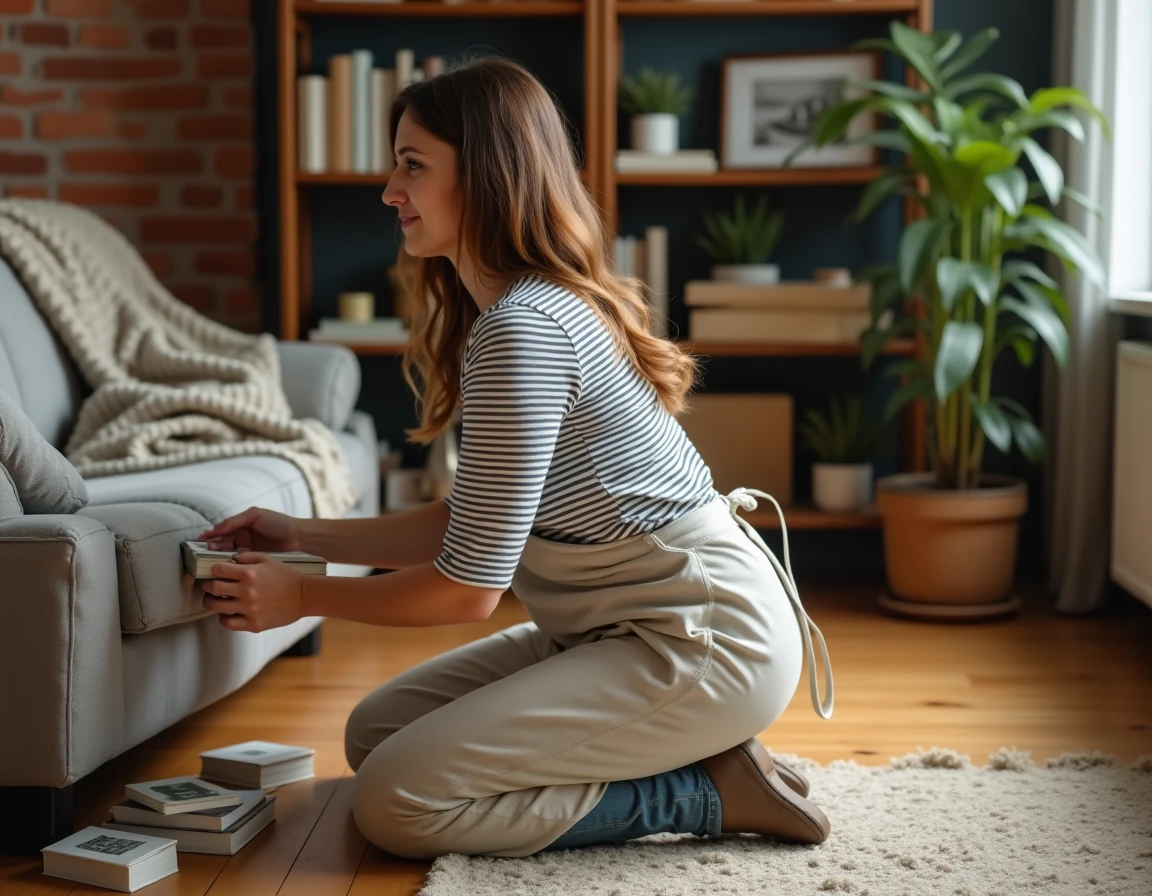
A pile of mail on the table, shoes scattered in the entryway, a desk overflowing onto the couch. The disorder in a home is not just an aesthetic problem. It generates a diffuse mental fatigue, a feeling of never truly being “at home” even within one’s own walls. Transforming this chaos into a warm and harmonious home is less about buying pretty objects and more about a reorganization thought out around real life.
Friction Points: The Real Cause of Persistent Disorder
Have you ever noticed that certain items always end up in the same wrong place? Keys on the kitchen counter, a backpack in the middle of the hallway, clean laundry left on a chair for three days. These situations have a name among decluttering professionals: friction points.
A friction point is an item whose storage requires more effort than simply placing it anywhere. The solution is not to tidy up more often, but to bring storage closer to the natural gesture. A hook at child height in the entryway, an open basket (not a closed drawer) near the door, a catch-all fixed to the wall at the exact spot where the keys land.
Decluttering coaches observe that reducing friction points significantly divides daily tidying time. The idea is not to hide everything, but to create a logical flow in each room so that tidying becomes a reflex rather than a chore. As explained by the articles from Conseil Habitat, moving from a chaotic house to a serene interior first relies on this functional mechanism.

Living Zones and Remote Work: Defining Space Without Partitioning
Since the rise of hybrid work, the demand for “home decluttering” has increased significantly. The living room serves as an office, the bedroom becomes a meeting room, and the kitchen table is piled high with files. This constant mixing of functions makes the home visually and mentally cluttered, even when it is tidy.
The most effective response does not involve partitions. It involves visual markers that separate living zones. A differently colored rug under the workspace. A light linen curtain hanging from a rod at the ceiling. A low back-to-back piece of furniture that creates a boundary without blocking traffic or light.
Creating Micro-Zones with Furniture and Textures
The choice of furniture plays a direct role in the perception of harmony in a room. Two simple principles work:
- Group elements by function (reading nook with an armchair, lamp, and low shelf, nothing else) so that each area has a readable identity at a glance
- Vary textures between zones (raw wood for the work area, soft fabric for the relaxation area) so that the brain perceives a change in atmosphere without needing walls
- Leave an empty space between two zones, even if narrow, to allow for smooth circulation and avoid a feeling of suffocation
This principle of circulation is, in fact, central to the feng shui approach. The energy of a room stagnates when furniture blocks pathways. Clearing the main axes between the door and the window allows for a visual balance and a sense of space, even in a small interior.
Circadian Light: The Most Underestimated Element of a Warm Interior
Most articles on decoration talk about “candles” and “string lights” to create an ambiance. This is insufficient. Research on light and well-being, notably relayed by habitat ergonomists, emphasizes the role of circadian light in the feeling of comfort at home.
The principle is simple. Natural light varies in intensity and color temperature throughout the day: bright and white in the morning, warm and soft in the evening. Reproducing this cycle indoors, with adjustable temperature bulbs, radically transforms the perception of a room.
Adapting Lighting Room by Room
In a cluttered home, exposure to natural light is often reduced by tall furniture, thick curtains, or stacked objects in front of windows. Before buying an additional lamp, one should clear existing light sources. Moving a shelf that blocks a window can change the entire atmosphere of a living room.
For artificial lighting, three levels are sufficient in most rooms:
- A soft general ceiling light (never cold white neon in a living space)
- A functional light directed at activity areas (desk, kitchen work surface)
- An ambient light at low height (floor lamp, wall sconce) with a warm adjustable temperature for the evening
This last level makes all the difference between a “lit” house and a home where one wants to stay.

Natural Materials and Plants: Grounding Harmony in the Concrete
Wood, linen, terracotta, wool: these materials bring a warmth that plastic or lacquered metal cannot replicate. Their irregular texture creates a sense of authenticity. A raw wood tray on a glass table, a wicker basket instead of a plastic bin for laundry, a wool cushion on a synthetic sofa.
Indoor plants play a similar role. They add life and organic colors without cluttering, provided they are chosen to suit the actual brightness of the room. A ficus in a dark corner will wither and add visual disorder. A pothos on a partially shaded shelf will thrive with no maintenance.
Every added element must solve a problem or serve a function. A purely decorative object that does not have a designated place will become, in a few weeks, just another item to move. The most effective rule for maintaining the harmony of an interior remains this: before bringing something into the house, decide where it will live. If the answer is “somewhere,” the object does not come in.